Case 01 · Enterprise IoT2024–2026
T-Mobile T‑Mobile for Business

IoT connectivity at scale for government and enterprise.

Drones, connected vehicles, fleet trackers and fixed sensors, managed across NB‑IoT, LTE‑M, LTE and 5G. Every enterprise deal reaches that fleet through one pipeline: lead conversion, a nine-section technical intake, quote, custom pricing, contracting.

Engagement
18 months, design lead
Pipeline
Lead → contract, 8 stages
Intake
Nine dependency-ordered sections
Networks
NB‑IoT · LTE‑M · LTE · 5G

It ran on disconnected internal tooling and manual intervention. This is the end-to-end redesign onto a single architecture.

Index IoT · 5G / LTE · B2B platforms · Pre-sales → contracting · CPQ · Global roaming
Jump to the system walkthrough →
Live schematic Fig. 00 · the architecture I owned — one record, eight stages, typed exceptions
Installed base
Record at stage
Exceptions typed
Contracts signed
Three decisions carry the system: one record across all eight stages, exceptions that are typed and owned rather than lost, and signed terms that re-score the next lead. I set that architecture and held it across sales, legal, pricing and engineering.
MetaEngagement
Role

Senior / Lead Product Designer

Lead designer for the migration program designing end-to-end CPQ and Quote-to-Order workflows. I trained six senior designers with the current TFB ways of working, team norms / cadence, as well as project expectations. I also designed the E2E IoT Connectivity quote-to-order flow for enterprise and government.
Owned
Pre-sales → sales → pricing → contracting → implementation
Decided
Intake dependency order, exception taxonomy, approval routing
Client T‑Mobile for Business Bellevue, WA · contract
Timeline Oct 2024 — Mar 2026 18 months
Partners IoT AE · Solution Architects · SI / PAPN Plus HSI / Collab / Security specialists and Solution Implementation Managers
Status Shipped to production with CPQ, contracting & Account Hub Six follow-on intake frameworks queued on the same pattern
Stack
FigmaSalesforce LightningGuideCX
Mockups Mockup representation

The end-to-end IoT Connectivity flow. Q2C: pre-sales, CPQ, and contracting.

Shown as mockup representations — the shipped production screens are under NDA.

*yes, i meant to put the em dash above

01Pre-salesSDR · Einstein + Pardot
Marketing · Einstein
Prospecting queue

Top 5 routed to sellers

RefreshRoute
AccountPardot gradeEinstein score
Atlas LogisticsA96
Cascade FreightA91
Meridian HealthB83
Pioneer UtilitiesB77
Northwind RetailB70
Routing cutline
Coastal TransitC58
Summit RoboticsC52
Delta Mfg Co.C44

The queue does the triage. Pardot behavioral grade and Einstein propensity score are pre-computed; the seller inherits a ranked list, not a cold pile.

Grade A · routed Grade B · nurture Grade C · held Product accent
02QualifyIoT AE · Einstein
Lead · L-590413
Lead · Atlas Logistics

Marcus Okafor · VP Fleet Ops

EditConvert lead
NewWorkingNurturingQualifiedConverted
Lead detail
Lead source
Inbound
Lead status
Working
Lead owner
Raf Laus
Lead age
132 days
Account segment
Enterprise
Est. lines / qty
38,500
Last touch campaign
Campaign · Q3 Fleet
Last activity
Oct 09, 2024
Product interest

Connected-vehicle fleet — embedded eSIM, EU + US roaming. Flagged by the “connected vehicles?” gate for the IoT Connectivity framework.

91 Lead scoreEinstein
Top positive

Landing-page views in the top 5% of all prospects this quarter.

Top negative

No form-tracker click-through in the last quarter.

Consent
Next best action

Book solution-architect intro — fleet size clears the framework threshold.

The record answers “why this one, why now.” Consent status, Einstein score, and a single recommended action sit beside the facts so the AE opens with context, not discovery.

03OpportunityIoT AE · entry point
OPP-40218
Opportunity · Owner Boris Lynch

Atlas Logistics — IoT Connectivity

New quoteQuote to contract
IdentificationBusiness needProposalVerbal awardContracted
Opportunity team
IoT Specialist
Lead
Industry Segment Advisor
ISA
Security Specialist
Sec
SE Specialist · 5G ANS
SE
Account Executive
Boris Lynch
Solution Architect
SA
Add intakeFramework catalog
IoT Connectivity framework9 sections
SASE / security framework6 sections
IBC / collaboration4 sections
+ Add IoT Connectivity intake
Related
Solution intakes
3
Quotes
1
IBC intake
0
Orders
1
Deal
Est. IoT lines38,500
Close dateQ1 2025
Next best action

Book technical discovery with the ISA before the intake.

The opportunity is the hub. It names every owner and holds the related quotes, orders and intakes; sellers launch the nine-section IoT intake directly from here, and drive the deal toward quote-to-contract.

04IntakeIoT AE · 9 sections
IoT Connectivity intake
01 Account02 Opportunity03 Solution04 Devices05 Network06 Coverage07 Rate plan08 Terms09 Review
Section 05

Network & APN

One answer sets the technology tier; the rest is derived from it.

Q5.1Primary network technology
NB-IoT LTE-M LTE 5G
Derived from LTE-M7 fields auto-filled
APN type
Private · static
eSIM profile
Local · roaming
Peak throughput
1 Mbps
Dormancy timer
Enabled
Owners
  • IoT AER
  • Sol. ArchitectA
  • Connectivity SIC
Autosaved · 10:41
BackNext

A near-hour form became a guided path. One technology choice derives APN, eSIM, throughput and dormancy — the AE confirms rather than re-enters, and downstream pricing reads the same fields.

05PricingSol. Architect · approval
Request-00187
Approval request · In review

IoT Connectivity — custom pricing

RejectApprove
Plan name
BMI25GBT · LTE
Contract
#4482301
Plan type
LTE · tiered
Submitted
Sep 12, 2024
Assigned to
Sales leadership
eSIM local profile
Included
Tiered pricing · per SIM / MRC
TierSIM rangeOn-net dataOverageMRC
Tier 11 – 5,0008 GB$0.011/MB$4.60
Tier 25,001 – 15,0008 GB$0.009/MB$4.10
Tier 315,001 – 30,00012 GB$0.007/MB$3.80
Tier 430,001 – 38,50012 GB$0.006/MB$3.55
Approval required — negotiated MRC below rack rate$150.00 → $42.00 → $38.00

Custom and special pricing, sized once. The tier table is computed from the fleet size captured at intake; the approval routes to sales leadership with the delta from rack rate already shown.

06ContractLegal + AE · CSCA
Contract · 00000451
Contract · Out for signature

Atlas Logistics — Master Corporate Service Agreement

Download PDFResend for signature
MCSA_Atlas_Logistics.pdf Page 1 / 4100%+
TFor Business Contract No. 00000451
Rev. 2 · 09/03/24
Agreement

Master Corporate Service Agreement

Provider
T-Mobile for Business
12920 SE 38th St
Bellevue, WA 98006
Customer
Atlas Logistics, Inc.
4400 Harbor Ave SW
Seattle, WA 98116

This Master Corporate Service Agreement (the “Agreement”) governs the provision of connected-device wireless services set out in Schedule A — IoT Connectivity, incorporating the approved rate framework and the terms below. Capitalized terms have the meanings given in Section 1.

Schedule A · IoT Connectivityfrom QtO-20241015
Rate planBMI25GBT · LTE tiered
Committed lines38,500
MRC (blended)$3.55 – $4.60 / line
Initial term36 months
  1. Term & renewal. Effective on the last-signature date; auto-renews in 12-month terms absent 60-day notice.
  2. Pricing. Tiered per Schedule A; negotiated rates below rack require the approvals recorded in the linked pricing request.
  3. Governing law. State of Washington, without regard to conflict-of-law rules.
TFB Contracts
PROVIDER · signed 09/12/24
CUSTOMER · awaiting signature
ConfidentialPage 1 of 4
Signature request · sent e-signature
Fromcontracts@tfb.example
Tom.okafor@atlaslogistics.example
SubjSignature requested — Master Corporate Service Agreement

Hi Marcus,

Your IoT Connectivity agreement is ready. It reflects the approved tiered pricing and the 38,500-line commitment from quote QtO-20241015. Please review and apply your signature — the Provider has already counter-signed.

PDF
MCSA_Atlas_Logistics.pdf
4 pages · 214 KB · Schedule A attached
Review & sign →
Link expiresSep 26, 2024 · 5:00 PM PT
Audit trailSent · viewed 2×

The contract is a quote that signs. Schedule A generates straight from the quote — same lines, same approved tiers — then routes for e-signature; the Provider counter-signs first, and the audit trail travels with the record.

07QuoteAE · Quote-to-order
QtO-20241015
Quote to order · Draft

Atlas Logistics — IoT Connectivity

Calculate pricingCustomer checkout
Product Shipping Order enrichment
Opportunity owner
Boris Lynch
Customer RFQ
RFQ-0004821
Parent contract
MasterContract · Level 1
Groups
GroupDue todayDue monthly
Plans / Solutions38,500 IoT lines · BMI25GBT$0.00$1,463,000
BYOD / SIMBring your own device$0.00$0.00
Devices / SIMs onlyeSIM · local profile$0.00$0.00
Accessories only$0.00$0.00
Total due monthly $1,463,000
Credit · details
Line credit limit
$900
Max credit limit
$180,000
Bill-to-BAN eligible
Yes
Data lines22 / 30
Voice lines3 / 5
IoT lines2 / 6
HSI lines1 / 4

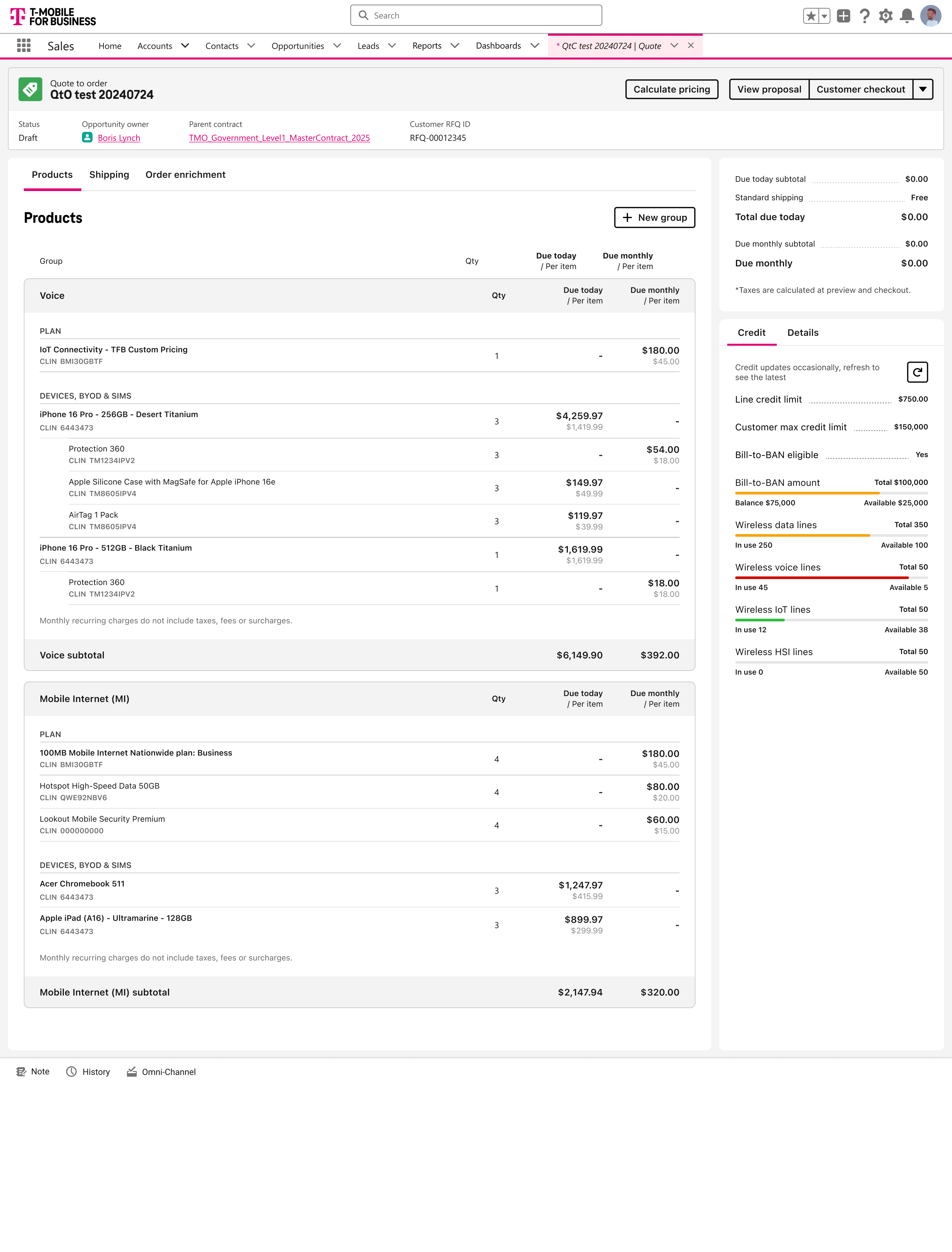
Downstream: the generated quote. Derived configuration flows into CPQ pricing without re-keying; credit ceilings and line availability sit beside the totals so checkout isn’t blocked by a surprise.

00 / ContextBackend transformation · first product without a catalog line

First, the product: IoT connectivity.

IoT connectivity is the cellular service that links a fleet of devices back to the business running them.

  • What is connected. Sensors, asset trackers, vehicle fleets, payment terminals, POTS-line replacements.
  • Scale. A consumer plan connects one person to one phone. An enterprise deal connects thousands of SIMs and eSIMs.
  • Network choice. NB-IoT and LTE-M for large low-power fleets. LTE and 5G for bandwidth-heavy, mission-critical ones.
  • What is sold. Rate plans, certified devices, APN / VPN security, international roaming, and a management layer to run it.
  • Consequence. A deal cannot be quoted from a price list.

Fig 1 · The connectivity spectrum the intake configures against. Four network technologies, from large low-power fleets to mission-critical workloads. The intake's network section maps each deal onto this curve.

DESIGN ASK 1

The backend transformation.

T‑Mobile for Business was moving prospecting and QTC / CPQ onto a new version of Salesforce on a new backend.

  • It replaced pricing spreadsheets and a standalone APN / VPN configurator.
  • It replaced email approval chains, SharePoint spec docs, and manual GuideCX hand-offs.
  • Once that work lived in one place, an intake could derive, route and audit instead of only collect.
DESIGN ASK 2

The first product without a catalog line.

Everything else on the platform sold from a catalog line. IoT connectivity has none.

  • A deal is a configuration of network technology, certified hardware, APN / VPN security, roaming and management layer.
  • So it has to be derived, priced and approved rather than picked.
  • Being first meant the framework had to hold for what came next. 5G Advanced Network Solutions and the other LTE offerings now run on the same intake, exception and approval pattern.
The problem

The intake was the symptom. The flow was the problem.

The nine-section intake was the visible pain.

  • Dual list pickers, multi-selects nested inside dropdowns, dependency links that opened other Salesforce records.
  • A 47-minute average completion time for trained IoT AEs.
  • The form was only where the damage showed. The deal it fed crossed disconnected systems from pre-sales to contracting.
  • Every handoff was re-keyed by hand.

So the scope was the whole flow: an Einstein-ranked lead through opportunity, intake, quote, pricing and contracting. What follows is what shipped inside the real constraints of two PM organizations, an enablement team and a CRM-generic design system. Where it matters, I show the version I would ship without them.

01
Pre-sales discovery
SDR + IoT AE
02
Sales qualification
IoT AE
03
Pricing & quote
Sol. Architect + ISA
04
Contracting
Legal + AE
05
Implementation
Impl. Mgr + SI/PAPN
Framework

02 / System walkthroughLead → contract → hub

Entry and end-points

Fig 1 — The deal-flow the framework now lives inside, on the consolidated platform. Intake feeds quote logic and custom pricing directly, not just the next step. The dashed edge is the reopen path: renegotiation at contracting edits pricing state, not documents.
Quote to Order · CPQ — Configure, Price, Quote 01 / 10
Convert lead · step 02 of 04

Is this customer already ours?

Two candidate accounts returned for “Atlas Logistics, Seattle”

Atlas Logistics Inc.Seattle, WA · in CRM 96match
Atlas Freight GroupKent, WA · not in CRM 72match
Create a new accountNo match above the threshold
Confirming a match imports the master record; the seller can also disqualify here. Confirm match →
Convert lead · candidate matching before a record is created
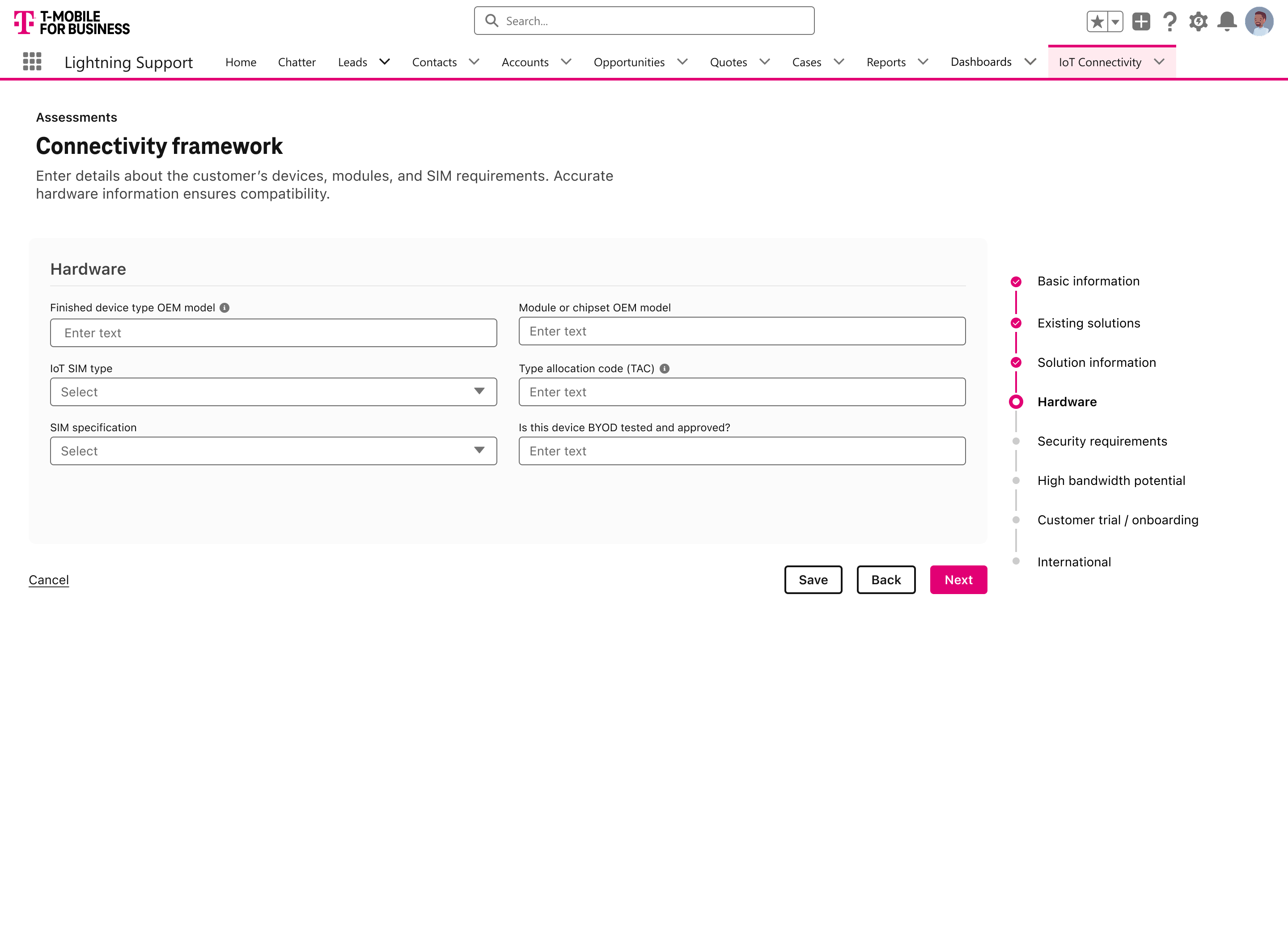
Connectivity framework intake, Hardware section: device and SIM fields with the nine-section progress rail.
Connectivity framework · Hardware section, nine-step rail
Quote to order screen: grouped product lines with due today and due monthly columns beside a credit panel.
Quote to order · grouped lines, credit and capacity rail
Pardot grade (stoplight) × Einstein score. The queue is ranked before a human touches it.
01 · Prospecting · Pardot + Einstein

The deal starts before the seller does.

Prospecting comes first. Pardot grades each account on engagement (a good / better / best stoplight) and Einstein scores predicted conversion next to it. My design problem was trust: sellers ignore a black-box score. The queue exposes why a lead ranks (grade, score, recency) so the ranking earns the right to order someone's morning.

Inputs: Pardot grade (stoplight) · Einstein score · MQL threshold

Salesforce Einstein
Salesforce's machine-learning layer. Lead scoring ranks each inbound lead by how much it has in common with leads that previously converted — the model retrains on the org's own conversion history (falling back to a cross-customer global model until there's enough data), refreshes scores through the day, and surfaces the fields that pushed a score up or down. That last part carried the design: the queue shows the top factors next to the number, the score routes attention rather than gating it, and a low-scored lead is still workable — the model orders the morning, the AE keeps the judgment.
Pardot
Salesforce's B2B marketing-automation product. It grades engagement (which whitepapers a prospect read, which webinars they attended) and feeds those signals into the same ranked queue.
02 · Lead lifecycle · match & convert

Optimizing at every step from creation to conversion

Creation, prospecting, disqualification, conversion — four states, one surface. The first question the system asks is whether this customer already exists: candidate accounts and contacts come back scored for confidence and flagged for what is already in CRM, so the seller confirms a match, disqualifies, or creates a record deliberately. It is the cheapest place in the pipeline to prevent a duplicate customer, and the most expensive one to skip.

Create · prospect · disqualify · convert · candidate matching before creation

03 · Lead conversion · Convert

One click turns the ranked lead into an opportunity.

Work top lead opens Convert: find or create the contact, attach the account, and the new opportunity inherits everything — Einstein score, consent state, duplicate warnings. Nothing is re-keyed between prospecting and sales.

contact · account · consent · duplicates → opportunity

04 · Sales opportunity · Entry point

The opportunity is the launchpad.

Everything hangs off the opportunity: the AE assembles the team, then launches work from it — start the IoT intake, create a quote (there can be many), kick off quote-to-order. One record owns the deal; every artifact that follows keeps a pointer back to it.

team · solution intake · quotes · orders

05 · Intake spine

Nine sections, one spine.

The intake replaced a Salesforce dual-list-picker maze with nine explicit sections. Each section is independently saveable and recoverable; a seller can stop mid-deal and another can resume with full context.

  1. 01Vertical
  2. 02Network
  3. 03Hardware
  4. 04Security
  5. 05Bandwidth
  6. 06International
  7. 07Resourcing
  8. 08Compliance
  9. 09Timeline

9 sections · resumable · visible authorship per edit

06 · Quote (Configure)

The catalog fork is the architecture.

Everything in the intake routes one of two ways: catalog items flow straight to quote logic; non-catalog needs become structured exceptions instead of email threads. Making the fork explicit is what lets the clean path stay fast.

2 paths · exceptions typed, owned, and tracked

Opportunity
INTAKE QUOTE
07 · Price (special / custom)

Special pricing without special chaos.

Connected-vehicle and SASE bundles, volume discounts, multi-year terms: the pricing surface composes them as visible deal components, each with its own approval chain. The seller sees what's standard, what's exceptional, and who owns the exception.

Components: base · hardware · CV bundle · SASE · discount

08 · Legal review

The risk sits where customer specificity meets legal review.

Legal sits with contracting; its job is reviewing the pricing team's work. A linear flow under-describes the real problem: dependencies, exception routes, ownership boundaries. The fix wasn't moving legal earlier; it was handing legal structured pricing output (typed components with approval chains) instead of email threads, so review starts from state, not archaeology.

Legal reviews pricing output at contracting · clause precedent library

09 · Contract (Quote → signed)

The contract is an audit trail that signs.

Every clause traces back to the intake section and pricing component that produced it. The package is traceable, reviewable, and handoff-safe; when negotiation reopens, the team edits state, not documents.

Clause ↔ section traceability · reopen without rework

10 · Order (Quote → Order)

Signature converts the quote into an order.

The signed quote drops straight into provisioning as typed order lines: SIM and eSIM activations, gateways, connectivity plans. Each line keeps its lineage back to the priced component, so fulfillment never re-keys the deal, and every line carries its own status from queued to provisioned.

Quote → Order · line-level status · no re-keying

11 · Implementation · account hub

Signature is the midpoint, not the end.

The fulfilled order instantiates the account hub: orders, SIM activation, fleet status, billing. Post-sale telemetry feeds the next renewal's lead score; the journey is a loop, and the design closes it.

Modules: orders · activation · fleet · billing · renewal signal

03 / The screens · Ranked lead → Account Hub

A ranked lead becomes an opportunity, many quotes, one provisioned hub.

Scroll →
Sales · Leads · Ranked queuePardot × Einstein
PROSPECTING QUEUE · TOP 5 ROUTED TO SELLERS
AccountPardot gradeEinstein score
Atlas LogisticsA94
Cascade FreightA89
Meridian HealthB81
Pioneer UtilitiesB74
Northwind RetailB68
Coastal TransitC57
Summit RoboticsC49
Delta Mfg Co.C41
It starts from a ranked list. Pardot grade × Einstein score order the queue before a human touches it.
Lead · Sunny Side Fleet Mgmt. · ConvertNew → Working
90
Einstein lead score+ Landing-page views top 5% No form-tracker clicks last qtr
Contact
Find existingNew contact
J. Ashford · Fleet Ops Director
Account
Existing accountCreate new
Dynamic Air Unlimited
Consent summaryEmail ● Opted inMobile ● Do not call
Account has 8 open opportunities2 potential duplicate leads found
Next best actionBook technical discovery w/ ISA
Convert: find/create the contact, attach an existing or new account — then it becomes an opportunity.
Sales · OpportunityEntry point
Opportunity · Owner: Ashford, JordanSunny Side Fleet Management
IdentificationBusiness NeedProposalVerbal AwardContracted
Opportunity team
IoT SpecialistLead
Industry Segment AdvisorISA
Security SpecialistSec
SE Specialist · 5G ANSSE
Account ExecutiveAE
Quick links
Solution intake3
Quotes1
IBC intake0
Orders1
IoT lines5
Voice lines0
The entry point. The opportunity names every owner — and from it, sellers launch many quotes and the IoT intake.
CPQ · Quote · Select planQ2C · Q2O
AllVoiceMIHSIIoT
PlanSOCMRC
Connectivity plan · T-PriorityBMI30GBT$164
eSIM activationsESIMACT$45
IoT Connectivity · TFB Custom PricingApproval req.Custom
Custom pricing requires approval before quote lock
Select plan feeds both paths — quote to contract (Q2C) and quote to order (Q2O) — from one CPQ surface.
CPQ · Approval request · Request-0005In review
Custom pricing — LTE PlanTiered · uses intake §5
TierRange (SIMs)Rate
Tier 10–500$3.20
Tier 2501–1,500$2.45
Tier 31,501+$1.90
SASE tier · StandardDerived · §5
Multi-year discountSales leadership · L3
Custom pricing reads the intake against the quote — each tier and component routes its own approval.
Contracting · Select a contract typeQ2C
Select contract→ Addendum→ Details→ Success
Parent Contract Sales AgreementEnterprise
Corporate Services Agreement (CSA)SMB
Customer PaperTheir template
Selected addendums
IoT connectivity SASE amendment Intl. roaming
Approvals still pending → items appear at rack rate. Negotiable items flagged for legal.
Quote to contract: an approved framework binds to each product, then legal selects standard + IoT addendums.
Provisioning · Order O-4471 · Quote to orderQ2O
CreditApproved
BAN994-201-88
Lines5
Plans · Solution · BYOD · Devices · Accessories
eSIM activations ×1,200Provisioned
Connectivity plan · T-PriorityProvisioned
Digi IX20 gateways ×1,200Queued

Each line keeps its lineage back to the priced component. Fulfillment never re-keys the deal.

Quote to order: signature drops the quote into provisioning as typed, status-tracked lines.
Account Hub · Acme LogisticsImplementation
Live modules
Orders3
SIM activation98%
Fleet online1,176
Renewal signalA · 0.81

Post-sale telemetry feeds the next renewal's lead score. The journey is a loop.

Implementation: the fulfilled order instantiates the hub — and closes the loop back to prospecting.
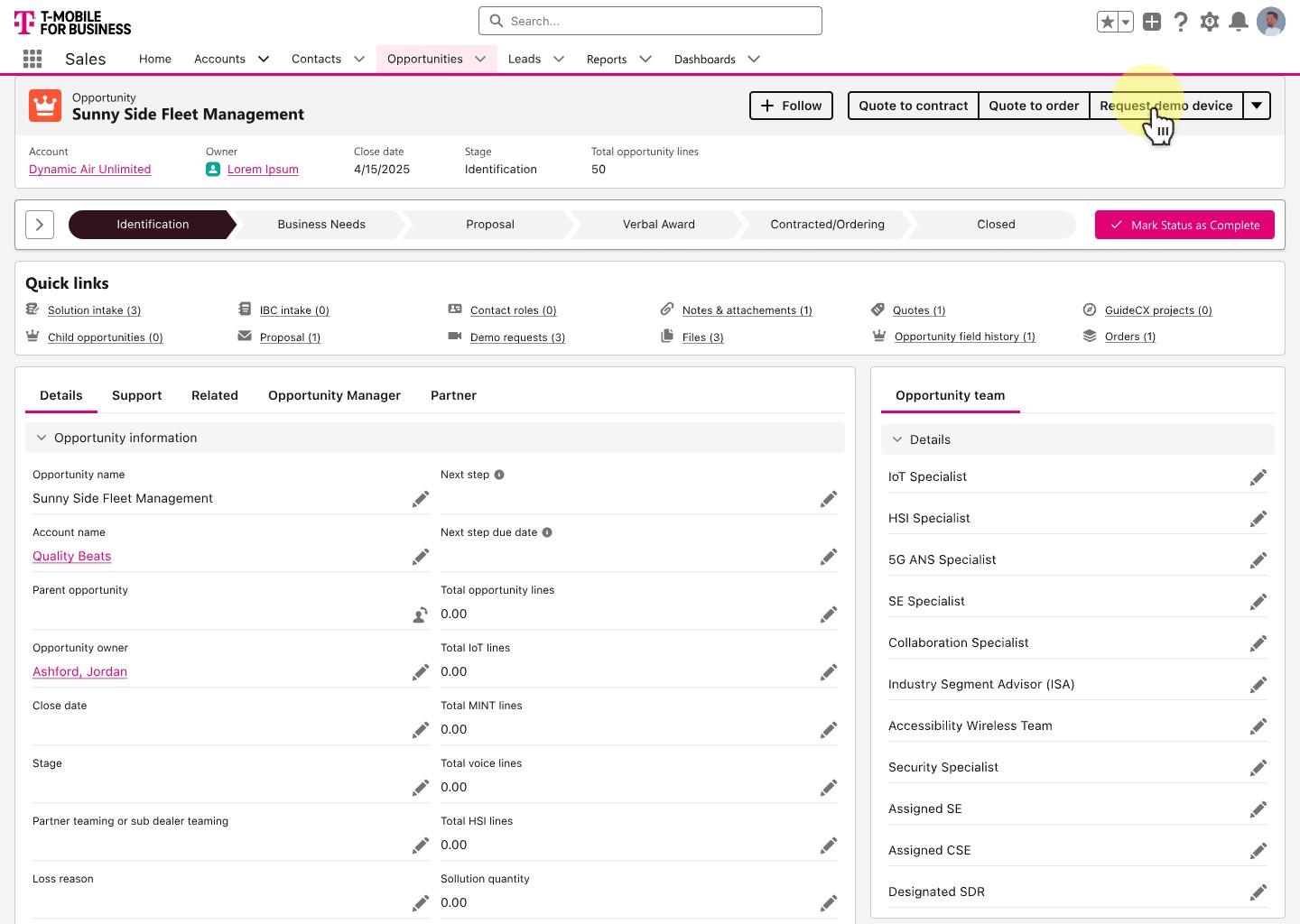
Hi-fi wire · Opportunity · production
Hi-fidelity wire — Opportunity record, Sunny Side Fleet Management
Why it matters: stage path, quick links to every child artifact, and the full specialist team on one record — the launchpad, as shipped to design QA.
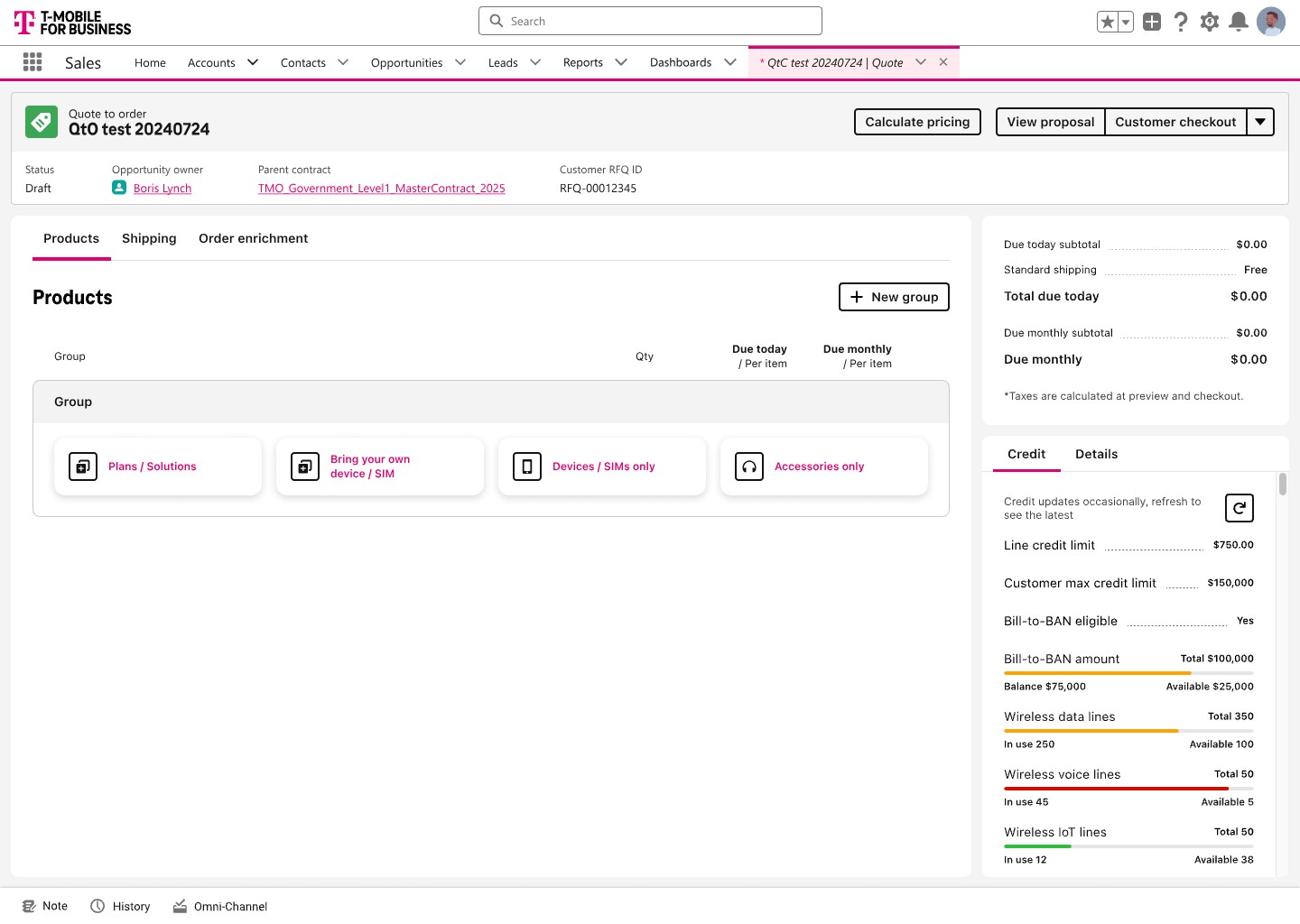
Hi-fi wire · Quote to order · production
Hi-fidelity wire — Quote-to-order screen with product groups and credit rail
Why it matters: product groups fork by fulfilment path, with the due-today / due-monthly ledger and live credit rail beside the configuration.
07 / AcceptanceDesign-ready ACs

The acceptance criteria the design must pass.

Written with engineering before pixels. If a screen can't satisfy these, the screen is wrong, not the criteria.

  • AC-01Every intake state is resumable by a different seller with zero verbal handoff.
  • AC-02Every exception has an owner and a visible status the customer-facing seller can read.
  • AC-03Every price component shows its approval chain before submission, not after rejection.
  • AC-04Every contract clause traces to the intake section and pricing component that produced it.
  • AC-05Reopening a deal edits state, not documents: no re-keying on renegotiation.
08 / Outcomes90 days post-rollout · directional reads

Faster intake. Fewer handoff rejections. More deals reaching contracting.

Outcomes were read jointly with business stakeholders and the business product managers who own the pipeline numbers — directional, not audited. Alongside the metrics: the shorter flows in this system were delegated to senior designers I trained on the framework, which is its own outcome.

08 Outcomes
A pipeline the business could finally reason about — directional reads, not audited metrics.
0.01Intake time Minutes Not an hour

From most-of-an-hour to minutes end to end · same AE cohort.

0.02Handoff rework Halved Sections kicked back

Roughly half as many sections returned by Solution Architecture.

0.03Velocity Up Pre-sales to contract

Median time-in-stage across the first 90 days of deals.

0.04Sentiment Positive AE cohort

Against sustained complaints on the legacy form it replaced.

09 / ReflectionDefend / what politics cost
What I'd defend

Treating the intake as a journey, not a form.

The framework is a baton crossing five organizational boundaries. Once that was named explicitly, every interaction decision (chip vs dropdown, conditional show/hide, smart defaults) had a principled answer.

What politics cost

The LLM intake. The mobile-first restructure for field reps.

Both are sitting in review. The version on this page is what shipped under enterprise design-system constraints; the unconstrained version would have launched months earlier.

How the team ran

I kept the spine; senior designers ran the branches.

I owned the intake architecture, the exception model, and every cross-boundary handoff. The shorter flows — demo requests, order enrichment, status surfaces — went to senior designers I trained on the framework, with acceptance criteria as the contract. Review was against the ACs, not my taste.

Where the AI goes next

From ranked queue to drafted intake.

Einstein orders the front of the pipeline today. The proposed next step is an LLM pass that drafts intake sections from the lead's own artifacts — RFQs, meeting notes — with the AE confirming instead of typing. Same principle as the queue: the model proposes, the human owns.