Post-acquisition Portfolio strategy DESIGN AND RESEARCH OPS

Continuous Discovery: one framework for 400+ websites after the Bayer acquisition

The Bayer Animal Health acquisition left Elanco holding 400+ websites and products with no shared way to assess them. Continuous Discovery is the operating framework I designed and ran in response — objectives, plan, problem, solution, deliverables — a timeboxed loop any team completes in one to six weeks. It became the default cadence for new teams, and its outputs seeded the design system and ElancoGPT.
Index Post-acquisition portfolio · Research ops · Timeboxed discovery · JTBD · OST · Service design · RACI
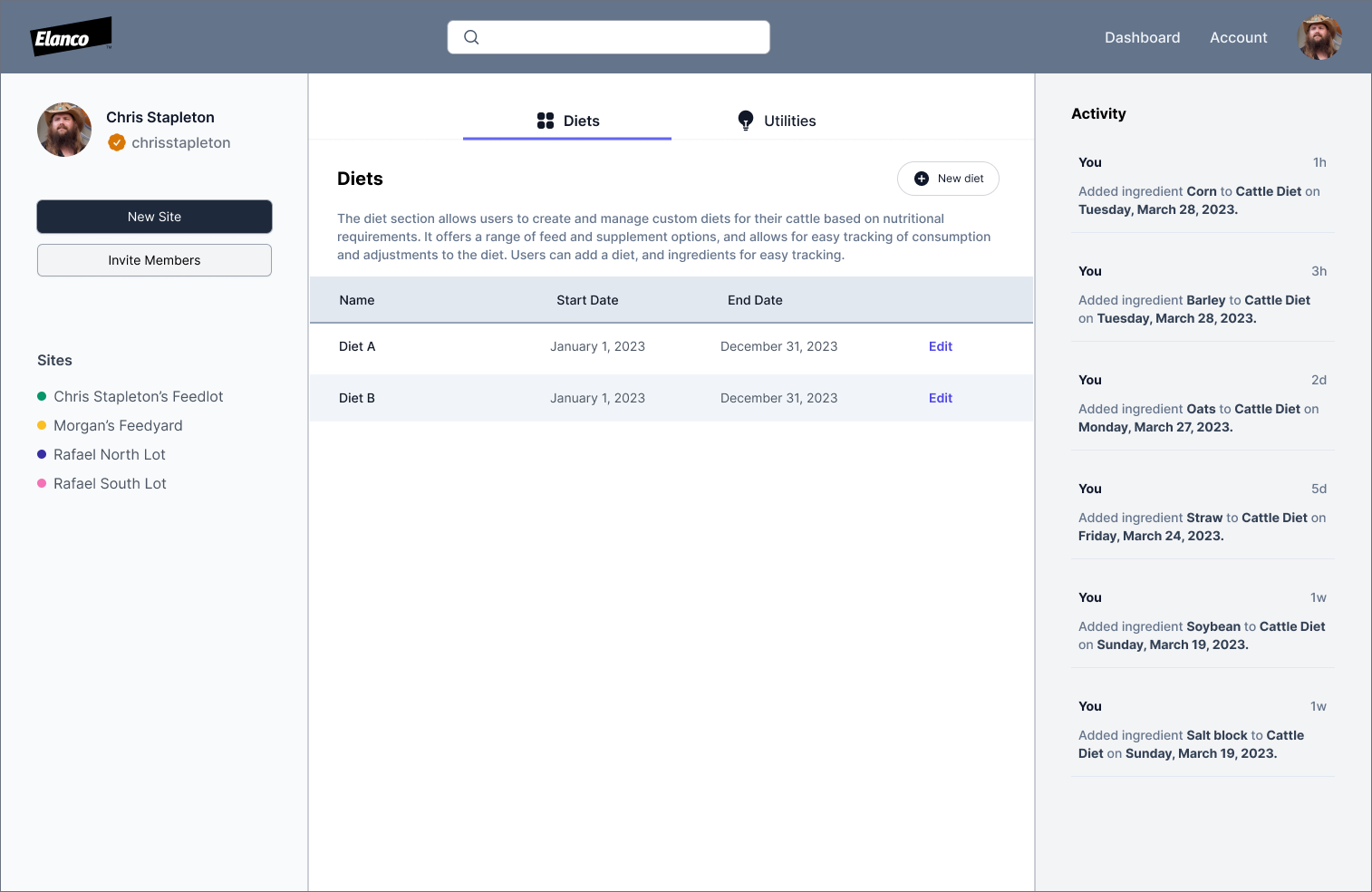
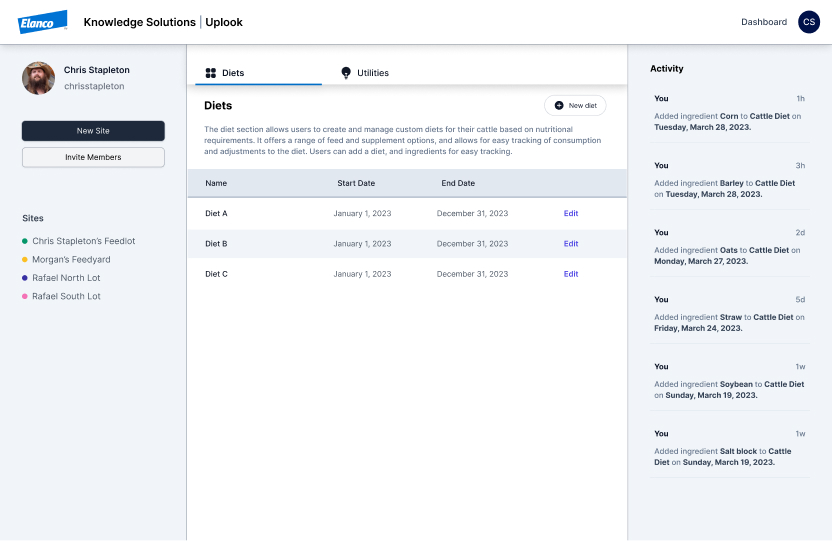
UpLook redesigned dashboard — Elanco Knowledge Solutions header, sites sidebar, cattle diets table with edit actions, and a live ingredient activity feed
Continuous Discovery & UpLook Re-design. The workspace the EKS Modernization cycle shipped — one site’s cattle diets, utilities, and activity in a single screen.
MetaEngagement
Role

Lead Product Designer

Framework owner, objectives through deliverables — org cadence, research ops, and the discovery program itself. Pre-discovery triage sat with Solution Engineering.
Company Elanco Animal Health Indianapolis, IN · Hook, UK
Timeline 2022 — 2024 Ran continuously as the standard cadence
Scope 400+ Websites & products across brands, species, and markets — two merged estates
Partners Product · DeliveryOps · Engineering Plus brand & regional stakeholders across both estates
Status Default discovery cadence for new dev teams Outputs seeded the Elanco Design System and ElancoGPT
Methods
InterviewsRACI stakeholder mapsExperience mapsJTBD opportunity statementsOSTUsability testingContent inventoryService / systems maps
400+Sites & products inherited

Two merged digital estates — Elanco’s and Bayer Animal Health’s.

5Framework stages

Objectives, plan, problem, solution, deliverables.

1–4Weeks, timeboxed

Research & design capped — then iterate or deliver.

2Triage gates

Pre-discovery, run by Solution Engineering — my ownership begins at objectives.

00 / BackgroundTwo estates, one company

The acquisition doubled the portfolio overnight. Nobody doubled the process.

The merger folded two companies’ digital estates into one — 400+ properties on different stacks, from different agencies, for different markets — and every keep, merge, retire, or rebuild decision needed evidence no two teams gathered the same way. My bet: treat discovery as a designed system. One week of setup, a hard one-to-four-week cap on research and design, a fixed deliverable set every cycle — a timebox that forces the only question a portfolio cares about: what do we know well enough to act on, and what earns another iteration?

01 / FrameworkThe actual artifact

Five stages, two gates, one loop.

This is the framework as teams saw it. Solution Engineering owned pre-discovery — the charter and DeliveryOps gates that keep unfunded work out. Everything from objectives to deliverables is the system I designed and ran; the loop back from delivery is what makes it continuous rather than a one-shot phase.
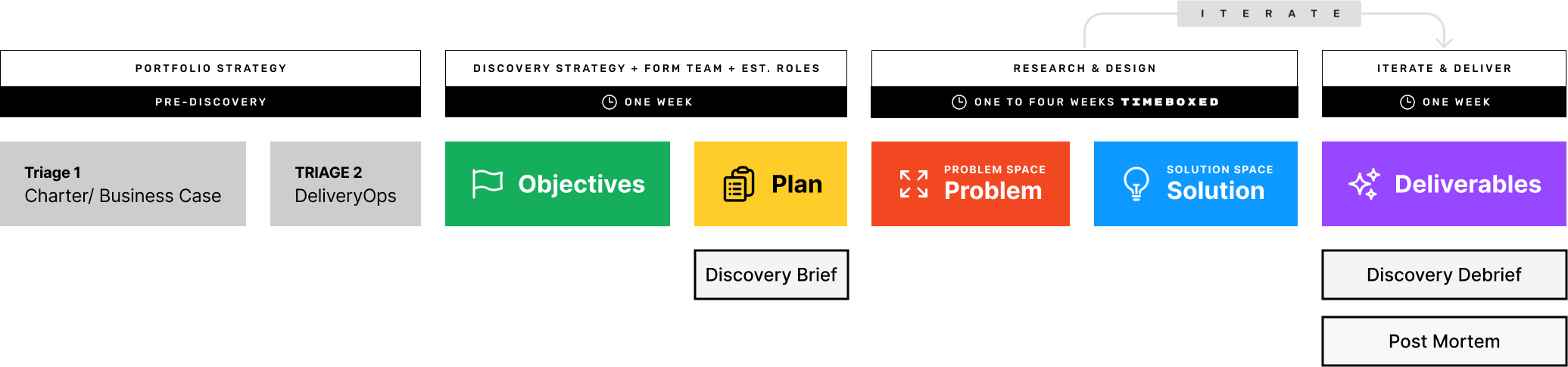
Continuous Discovery process: pre-discovery triage (charter/business case, DeliveryOps), discovery strategy and team formation in one week, research and design timeboxed one to four weeks across problem and solution spaces, then iterate and deliver in one week ending in a discovery debrief and post-mortem.
The operating spine. Solution Engineering runs the two pre-discovery gates; from objectives on, the loop is mine — one week of setup, a hard one-to-four-week research & design timebox, and a one-week deliver window that closes the cycle or earns it another iteration.
GATE

Pre-discovery triage

Solution Engineering

Charter / business case, then DeliveryOps. No gate, no team. Owned upstream — my system starts where this ends.

01 · 1 WK · MY SCOPE →

Objectives + plan

Strategy · form team · roles

Discovery assessment, stakeholder ID, discovery brief, brief deck, kickoff. One week, no exceptions.

02 · 1–4 WK

Problem space

Research · timeboxed

Interviews, RACI, experience maps, usability testing, tech research, content inventory — framed as JTBD opportunity statements.

03 · SAME BOX

Solution space

Design · same timebox

Affinity mapping, journeys, personas, wireframes, prototypes, tech POCs — converging on an opportunity solution tree.

04 · 1 WK

Iterate & deliver

Debrief · post-mortem

Discovery debrief, debrief deck, journey / service maps, user needs statements. Iterate loops back; deliver closes the cycle.
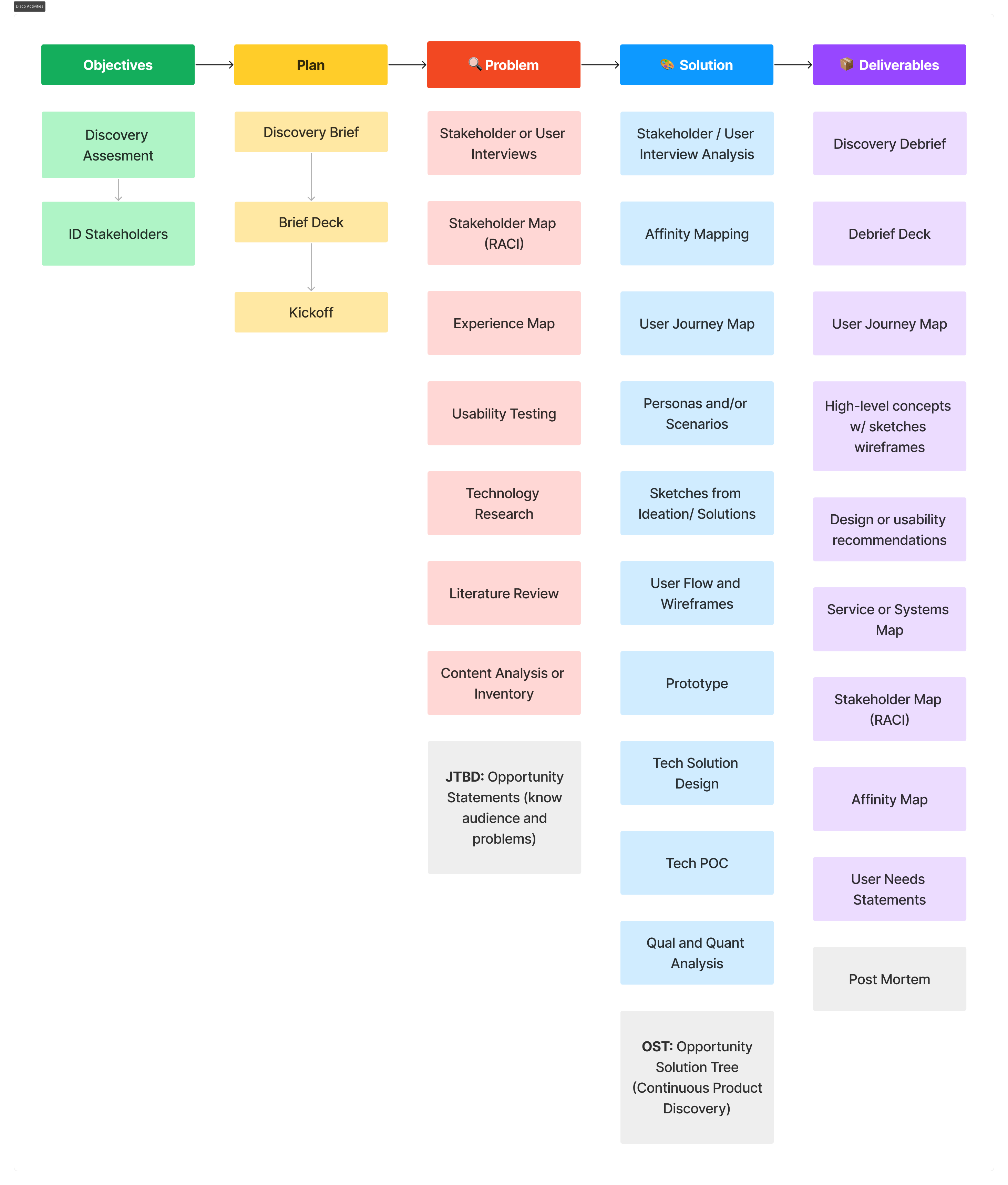
Continuous Discovery activities board: objectives (discovery assessment, ID stakeholders), plan (discovery brief, brief deck, kickoff), problem-space activities (interviews, RACI stakeholder map, experience map, usability testing, technology research, literature review, content inventory, JTBD opportunity statements), solution-space activities (interview analysis, affinity mapping, journey maps, personas, sketches, user flows and wireframes, prototype, tech solution design, tech POC, qual and quant analysis, opportunity solution tree), and deliverables (discovery debrief, debrief deck, journey map, concepts, recommendations, service map, RACI, affinity map, user needs statements, post-mortem).
The activities board. The menu each team drew from per stage — scoped to the timebox, not the other way around. The deliverable column never changed, which is what made cycles comparable across the portfolio.
Portfolio, through the framework01 / 05
400+ inherited properties. Two estates. No shared shape.
01 · Intake

400+ properties. Two estates. No shared shape.

Brand sites, species portals, product pages, internal tools — from two companies, dozens of agencies, and every era of the web. The portfolio couldn’t be reasoned about because no two properties had been assessed the same way.

Post-acquisition estate · Elanco + Bayer Animal Health

02 · Triage

Two gates sort the portfolio before any discovery spends a dollar.

Gate one asks for a charter and business case; gate two asks DeliveryOps whether a team can carry it. Properties route toward modernize, merge, keep, or retire — only the ones that clear both gates get a discovery team.

Pre-discovery · run by Solution Engineering → hands off to my loop

03 · Timebox

Weeks, not quarters.

One week to form the team and plan. One to four weeks — hard cap — for research and design. One week to iterate and deliver. The timebox is what let the same designers cover a portfolio instead of a project.

Setup 1 wk · research & design 1–4 wk · deliver 1 wk

04 · Contract

Each stage commits to an output the next stage can depend on.

Objectives commits to named stakeholders. Plan commits to a kickoff-ready brief. Problem commits to JTBD opportunity statements. Solution commits to an opportunity solution tree. Discovery became legible because every stage had a contract, not a vibe.

Objectives → plan → problem → solution → deliverables

05 · Deliver

Every cycle ends on the same four artifacts.

Debrief deck, journey map, service / systems map, post-mortem — identical shape whether the cycle took one week or six. Comparable outputs are what turned hundreds of one-off assessments into a portfolio view — and what the design system and ElancoGPT teams built on next.

→ EDS · → ElancoGPT · → portfolio decisions

02 / One cycleEKS Modernization · UpLook
What UpLook is

UpLook is the feedlot-management tool inside Elanco Knowledge Solutions — one of nine proprietary services for Beef and Dairy operators. One workspace per site: build and edit cattle diets by ingredient, track utilities, and read every change in a live activity feed. EKS Modernization rebuilt it into the shape later properties were measured against.

Inside one cycle: EKS Modernization.

EKS Modernization was the program that redesigned UpLook, Elanco Knowledge Systems’ feedlot management tool; this cycle ran against Passport, its enrollment system. Objective: enable self-service onboarding for Beef and Dairy customers by naming the customer-experience, business-process, and technology changes required. Below is the cycle’s output — decisions, not decks.

RQ1 · Current state

What are the key pain points for Uplook customers in Beef and Dairy in the current EKS Passport onboarding? → Stakeholder map + interviews, current-state service blueprint.

RQ2 · Future state

How do we design self-service onboarding that improves CX while holding security and compliance? → Future-state blueprint: the operational foundation for a new service.

Evidence base12 interviewsAccount reps, technical consultants, EKS Ops + Innovation, marketing / sales — the end-to-end enrollment chain
Analysis3 passesTranscript + notes analysis, sentiment analysis, affinity mapping
BlueprintsCurrent + futureFrontstage / backstage service blueprints across the line of visibility
TimeboxHeldDebriefed in 60 minutes · five agenda blocks · Nov 2022

Twelve interviews affinity-mapped into three themes — self-service enrollment, data validation & accuracy, communication & collaboration — answered by four recommendations:

REC 01

Make the sales process legible.

Clearly communicate who does what across account reps and sales in fulfilling enrollment — the role confusion was the top frontstage pain.

REC 02

One source of truth for forms.

Sales rep, EKS team, and customer see the same information — ending the version drift that stalled enrollments.

REC 03

Automate what CRM already knows.

Sync form fields with CRM and identity management to cut form errors, manual data entry, and documentation churn — the backstage cost driving onboarding delay.

REC 04

Standardize the enrollment steps.

Eight general enrollment steps — select, initiate, configure, provision, migrate, train, integrate — became the backbone of the self-service flow and the modernized UpLook below.

Modernized UpLook desktop dashboard: Knowledge Solutions header, sites sidebar, Diets table with edit actions, and an ingredient activity feed
Where the cycle landed. The modernized UpLook — diets, utilities, and per-site activity in one workspace; the shape later properties were rebuilt toward.
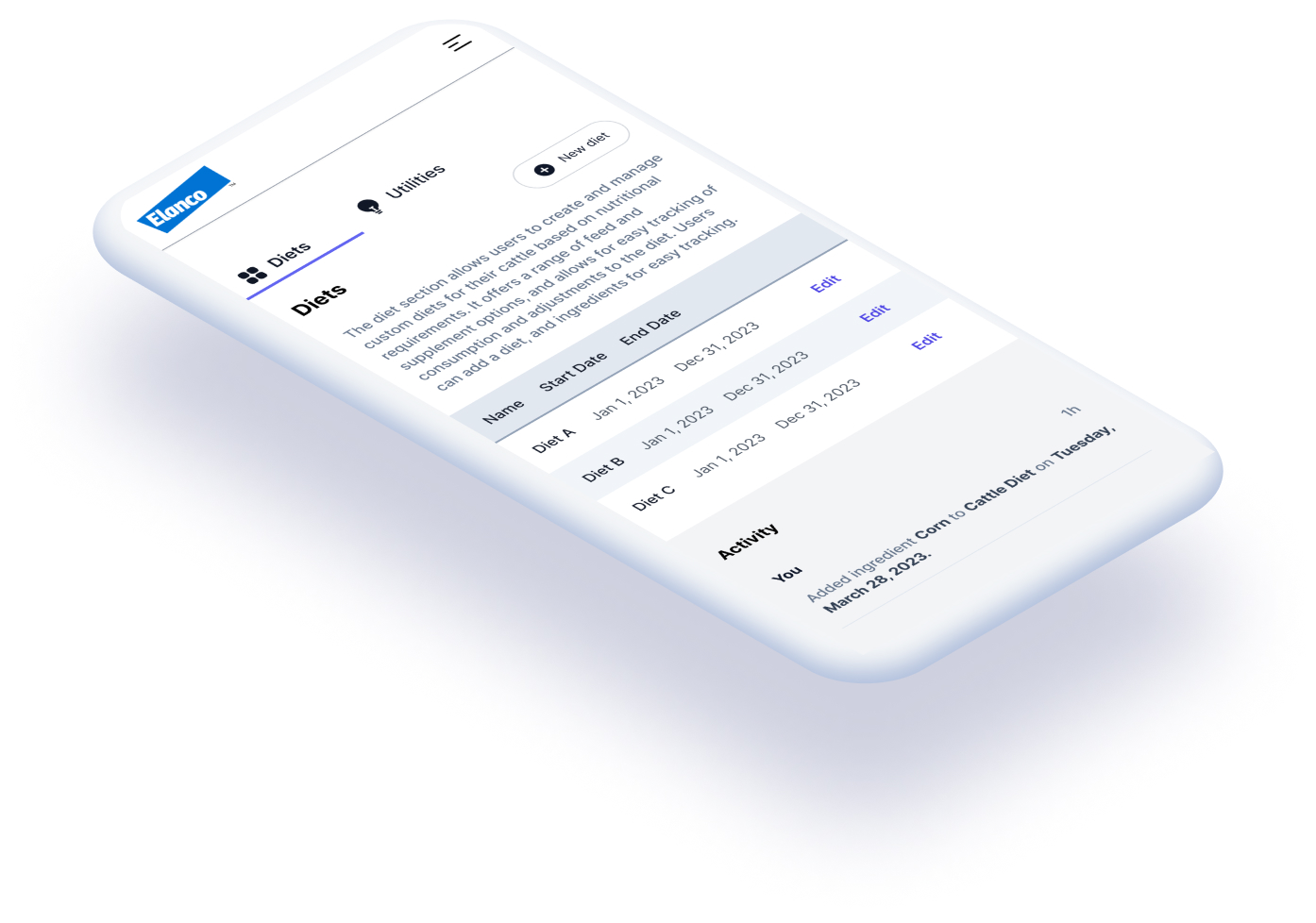
UpLook mobile mockup on a floating device: Diets list with start and end dates and the activity feed
Responsive from day one. Feedlot operators work from the lot, not a desk.
03 / ArtifactsFrom live cycles

What a cycle actually produced.

Full decks don’t belong on a portfolio page, so each is reconstructed as data — rebuilt from the EKS Modernization debrief and the Project HoneyBee kickoff + case study. HoneyBee ran first — the lower-stakes cycle that proved the loop before it carried the higher-stakes EKS / UpLook rebuild. Originals available on request.

Debrief deck. EKS Modernization: 27 slides, five agenda blocks, debriefed in 60 minutes — interviews, findings, blueprint, recommendations, next steps.
Journey map. Eight enrollment steps, frontstage to backstage — the current-state blueprint behind self-service.
Opportunity solution tree. One objective, three themes, four recommendations that moved forward.
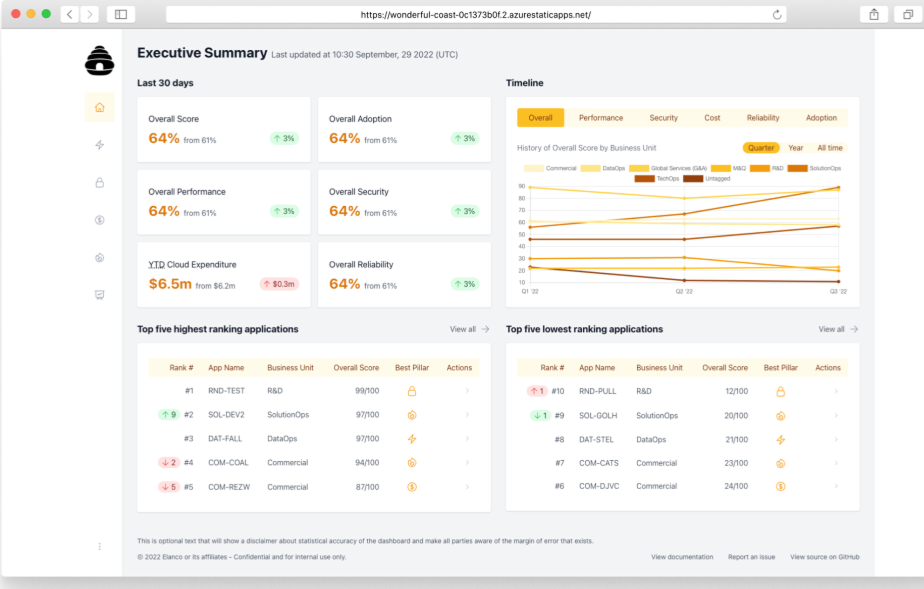
Project HoneyBee cost-spend dashboard — executive summary showing overall score, performance, security, cost, reliability and adoption by business unit, plus top and bottom ranked applications
Project HoneyBee — the cost-spend dashboard. The first cycle through the loop — a lower-stakes proving ground before EKS / UpLook. An executive summary of cost, security, reliability, and adoption across business units. Discovery named its primary user and the themes the MVP was scoped against.
AS
Adrian Sellers System Custodian / Delegate Indianapolis, IN
“Tell me what I need to do. If it doesn’t drive action, it won’t work.”
Goal
Maintain system & app health — monitor alerts, triage security vulnerabilities, and remediate on standardized processes.
Traits
Task-oriented · data-driven · strategic · analytical
Who it’s for

HoneyBee’s primary user is the System Custodian / Delegate — the person accountable for keeping a portfolio of applications healthy. Discovery framed the whole dashboard around one test: does a screen turn a signal into a next action?

Why it went first

An internal, read-mostly tool with a known audience carried less risk than a customer-facing rebuild — the right place to run the loop end-to-end and pressure-test the deliverable set before EKS / UpLook.

04 / OutcomesDirectional reads

A portfolio the business could finally reason about.

Outcomes below were read with the product managers and DeliveryOps leads who owned the portfolio — directional, not audited metrics.

Discovery cycle timeWeeks, not quartersTimeboxed 1–6 weeks end to end · previously open-ended
AdoptionDefault cadenceNew dev teams onboarded onto the framework as standard
Portfolio coverageBroadRepeatable triage across the 400+ inherited properties
DownstreamEDS + ElancoGPTBoth built directly on discovery outputs
05 / ReflectionDefend / redo
What I'd defend

The hard timebox.

Open-ended research is how a 400-site portfolio stays unassessed forever. Capping research & design at four weeks — and letting iteration earn more time — is the single decision that made coverage possible.

What I'd do differently

Ship the triage gates first.

The gates arrived after the first cycles, so early teams ran discovery on properties that were later retired anyway. Gating the portfolio before designing the loop would have saved those cycles.